Showing posts with label tools. Show all posts

Monday, May 28, 2012

A Declaration

After yesterday's deck and spar work, I was pretty motivated today.  For starters, I trimmed the decks to fit the hull, and sanded them smooth.  Then we set sawhorses under the hull and flipped it over, to begin work on the exterior. The goal is to "radius" the seams - that is, to turn them from angular meetings of two sheets of plywood, to gently curved transitions that can be smoothly covered with glass tape.

Using my trusty 4-in-hand file, some 60-grit sandpaper, and the block plane, I proceeded to radius the entire length of all three seams in about an hour and a half.  It went much faster than anticipated, but I suspect I'm going to be really, really sore tomorrow.

Soon - maybe even later today - I'll make a small batch of filleting epoxy and touch up the gaps in the seams.  Then it will be time to glass 'em, and do the final epoxy-coating of the exterior.

Translation:  I'm within sight of completing the hull.  Emboldened by this realization, I've decided to state publicly that I will launch this boat in June. 

There, I said it.  And now it remains to be seen whether I can put my money where my mouth is.  Stay tuned....

Monday, May 21, 2012

The Joy of Sanding

On the list of books nobody ever wrote, The Joy of Sanding has to be pretty near the top.  It's simple drudgery.  But if you don't like sanding, you probably shouldn't build a boat, and if you build a boat despite your dislike for sanding, you can't really expect anyone to feel sorry for you. 

Power tools make any task go by more quickly, but the odd angles and precision required by sanding the interior fillets on the Melanesia hull just don't work well with any power sander I can think of.  So if you're doing all the work, you'll want to make sure you have the right tools for the job.

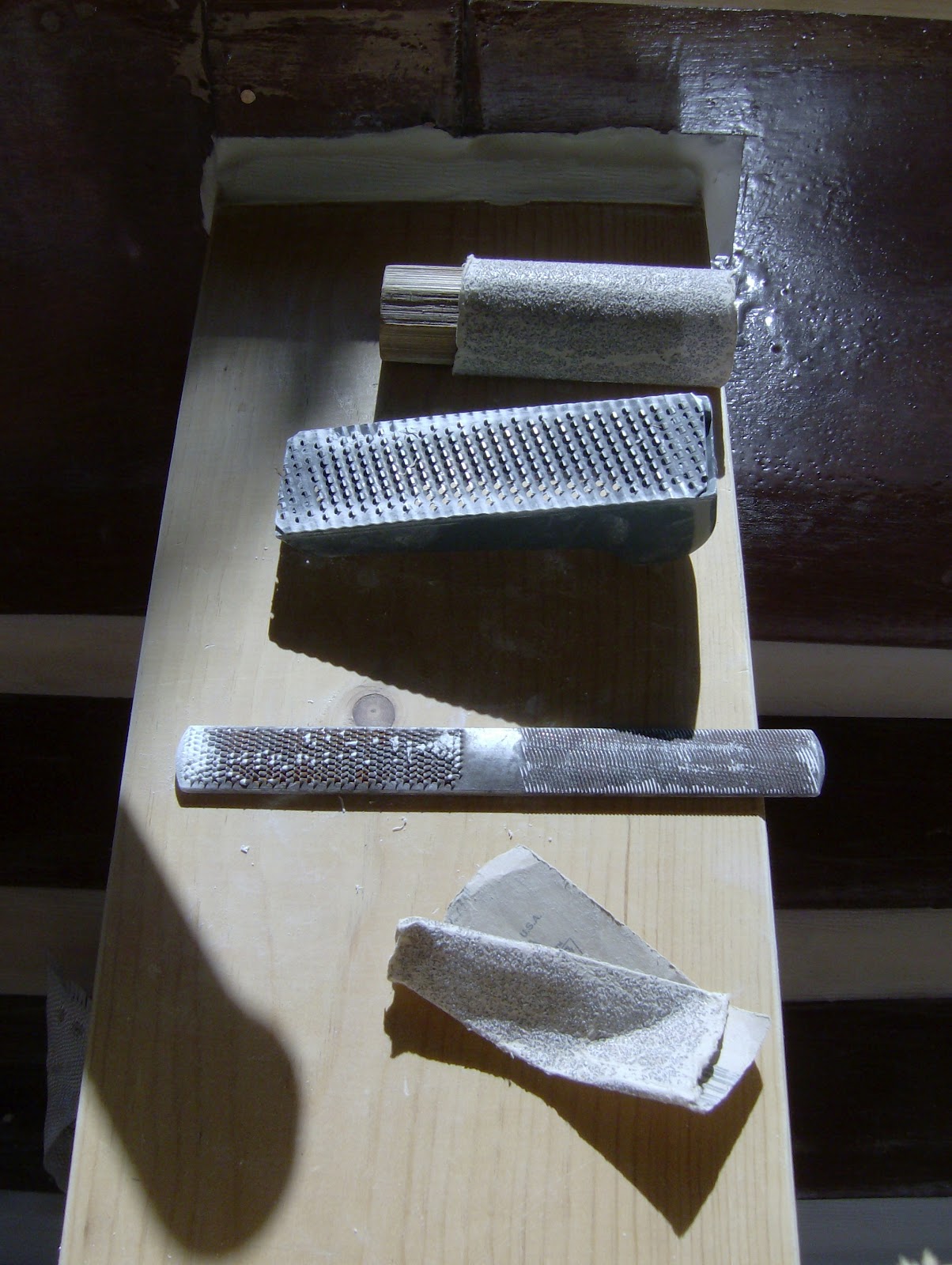
When I stepped onto the porch this morning, I found this unintentional still life on the center thwart.  These are the tools I've been using to smooth my fillets, laid out of the way while I vacuumed the dust out of the hull.  I've been using these tools:
  • coarse (60 grit) sandpaper wrapped around a rough cedar dowel that might end up as a T-handle for one of my paddles, for sanding the curved fillets;
  • a SurForm (surface-forming) plane;
  • a 4-in-hand rasp that I think I found in the street years ago.
  • and a folded scrap of 60 grit sandpaper for the fine work
Of these, the 4-in-hand rasp has been the most useful.  It's great for knocking down high spots, and I've found that it chews up the fluffy fillet epoxy nicely, but doesn't really dig into the pure epoxy coating on the wood, so it's great for smoothing down the raised edges of the fillets where I peeled back the masking tape.

The point of all this is - of filleting in general, and of sanding the fillets smooth in particular - is to provide a very smooth, gently curved transition from one panel to the other.  Well-supported fiberglass tape has excellent tension strength, but if you put a hard corner in it, or leave a gap beneath the tape, you're creating concentration of stresses that will eventually become a point of failure.

The good news is that it's not finish sanding.  The epoxy will fill any scratching left behind by the coarse sandpaper or the even coarser rasp. 

Anyway, in my own build, I'm almost done sanding and hope to put the first glass tape on today.  That's a real milestone, and I'm excited to move beyond the fillets to the next stage of things.

Monday, June 13, 2011

Cuts Complete, Building Begun

After all the work it took to loft the patterns onto my plywood, actually cutting the pieces out was almost anticlimactic.  It took two modest chunks of my weekend and required no help, whereas the lofting took a long evening and another entire morning with help from my kids.

I had thought about using the Japanese pull saw for much of this process, but that didn't work out.  I have trouble controlling the direction of my cuts as closely as I'd like with that saw, and it's not exactly gentle on the top veneer of the plywood, either.  My trusty circular saw is easier to hold straight, and chips the veneer less to boot.  By adjusting the saw for a pretty shallow depth, I was able to cut the gentle curves of the side and bottom panels with it.  I used my brother's jigsaw on the really curvy parts, like the stem and stern posts.

The only problem with the circular saw is that it has a very wide kerf.  "Kerf" is the portion of your wood that is turned into sawdust by the action of the saw.  My circular saw is fitted with a nice carbide-tipped blade that's at least 1/4" thick at the cutting tips, so it chews a good 3/8" path through the plywood.  The jigsaw was closer to 1/8" kerf, and the pull saw is even thinner than that.  So any time two pieces were really close together on the plywood, I'd set the circular saw aside and pick up the pull saw for that portion.

In the end, I am pretty happy with the accuracy of my cuts.  I think they're all within working tolerances, and I didn't make any expensive errors that require another sheet of plywood to fix.  I'm afraid I don't have pictures at this time, but I'll try to post some soon.

The end of the cutting process leaves one with six ~8' panels - two for the bottom and two for each side; a bow and stern deck; a number of delicate arcs to reinforce the midships end of the decks; scrap for butt plates and lashing pads; and two each stem post and stern post.  These last are duplicated because they're laminated to double thickness; Sunday night, with a little spare time on my hands, I decided to go ahead and laminate them.

I mixed a single-pump batch of System 3 epoxy, spread it liberally on both mating surfaces, and joined them.  After wrapping the whole affair in plastic bags to keep from accidentally bonding tools to the work, I clamped each set of posts with 4 clamps, 2 of which were on chunks of scrap wood to distribute the load.  A day later, they look pretty good - solidly joined and lined up correctly with each other. 

Next up, I need to build a way to stow the long panels when they're joined.  I plan to hoist them overhead into the rafters on the porch; I'll try to diagram or photograph that system for a future posting.