I mentioned recently that I was out of glass bubbles (an important filleting additive) and getting low on epoxy. So I've placed another order with Merton's, to the tune of $67.24. This brings the epoxy lineitem in my budget up to $243.76, and the total cost thus far to $595.89.
For those of you keeping score at home, that's around $150, or roughly 33%, over the initial budget estimate, which I arrived at by converting Wharram's budget estimate from British pounds to US dollars.
But the "good news" is that I'm not only well over budget, I'm also well behind schedule. Extra time means extra time to save money towards the build. So while I'm not thrilled to be over budget, I do at least have the money to spend. If I had reached this point in the build last fall, I would have had to put the build on hold while I saved up for more materials.
Oh, and that Merton's box showed up yesterday, so I should be able to produce some more construction news shortly. That's all for now.
Showing posts with label budget. Show all posts
Showing posts with label budget. Show all posts
Tuesday, May 1, 2012

Wednesday, June 15, 2011
Big Spender!
My tight budget finally reached the point where I was able to order the epoxy, fiberglass tape, and other specialty supplies needed to assemble the hull. So today, I placed an order with Merton's Fiberglass & Marine Supply for those materials. Their prices were good, their website informative. They don't do e-commerce, but they took my order over the phone (~$155) and promised to ship it out later in the afternoon.
There were a few decisions to agonize over in this purchase. First of all, what epoxy to use? Since I was given some cast-off System3 epoxy, with mixing pumps, from a friend's Eastport Pram build, it seemed best to stick with that brand. Next, what size? The cost per unit drops steadily as the size of the container goes up. The plans recommend (3) of the West System "A" size packs, which are about a quart each; Mertons' offered System3 in 0.75gal or 1.5gal sizes. The bigger size was very tempting, especially because the smaller pack is probably not quite enough to build this boat. But I still have a quart or so in the hand-me-down jugs, so I decided to stick with the smaller pack.
Next, I turned to sailcloth. Sailrite sells a 4oz Dacron (polyester) sailcloth for $11.95/yard, but I calculated that I'd need 5 yards of it. Sixty bucks is a bit expensive, especially if one makes a mistake with it. I found a local supplier - Rockywoods Fabrics in Loveland, CO, mentioned earlier in the blog - who carry a 4.5oz ripstop polyester fabric for $5.09 per yard. That puts 5 yards into the ballpark of polytarp costs (around $23 at Home Depot for a tarp large enough to make the sail, -vs- $26 for the Rockywoods deal). I'm sure the Dacron sailcloth would be superior, but I'm just as sure the sail's performance will be limited by workmanship more than materials in any case. So Rockywoods wins.
And speaking of workmanship, the plans discuss in detail how to finish the edges of the sail, but they don't discuss how to stitch the two panels of the sail together. I've never done this sort of thing before, so I'm a bit concerned about that.
Proa enthusiast Tim Anderson to the rescue. His account of sailing around Yucatan in a homebuilt proa included some notes and drawings of various stitch and seam types. (Search for "seam" to find the relevant passage, or just read the whole account if you need a little entertainment.) On the basis of Tim's discussion, I'll be joining the halves of my sail with a felled seam and avoiding "Frankenstein" stitching.
The next big steps out here are to butt the hull panels together and coat all interior faces with a layer or two of epoxy. Until the Merton's order shows up, I'll be spending my spare time on those tasks. More news as it happens.
There were a few decisions to agonize over in this purchase. First of all, what epoxy to use? Since I was given some cast-off System3 epoxy, with mixing pumps, from a friend's Eastport Pram build, it seemed best to stick with that brand. Next, what size? The cost per unit drops steadily as the size of the container goes up. The plans recommend (3) of the West System "A" size packs, which are about a quart each; Mertons' offered System3 in 0.75gal or 1.5gal sizes. The bigger size was very tempting, especially because the smaller pack is probably not quite enough to build this boat. But I still have a quart or so in the hand-me-down jugs, so I decided to stick with the smaller pack.
Next, I turned to sailcloth. Sailrite sells a 4oz Dacron (polyester) sailcloth for $11.95/yard, but I calculated that I'd need 5 yards of it. Sixty bucks is a bit expensive, especially if one makes a mistake with it. I found a local supplier - Rockywoods Fabrics in Loveland, CO, mentioned earlier in the blog - who carry a 4.5oz ripstop polyester fabric for $5.09 per yard. That puts 5 yards into the ballpark of polytarp costs (around $23 at Home Depot for a tarp large enough to make the sail, -vs- $26 for the Rockywoods deal). I'm sure the Dacron sailcloth would be superior, but I'm just as sure the sail's performance will be limited by workmanship more than materials in any case. So Rockywoods wins.
And speaking of workmanship, the plans discuss in detail how to finish the edges of the sail, but they don't discuss how to stitch the two panels of the sail together. I've never done this sort of thing before, so I'm a bit concerned about that.
 |
| Tim Anderson's illustration of a felled seam |
The next big steps out here are to butt the hull panels together and coat all interior faces with a layer or two of epoxy. Until the Merton's order shows up, I'll be spending my spare time on those tasks. More news as it happens.
Friday, April 15, 2011
Got the Plywood
Stopped at the local family-run wood shop today and bought 2 sheets of "Hydrotek 6mm Marine Ply 4x8 1/4" 5-ply BS1088 Meranti, No Face Defects, No Core Voids" plywood for $51.85 each. With tax, it came to $111.53.
Had a heck of a time getting them home in the force 6-7 winds that came through town today, but we managed. They're on the porch awaiting the next step, which is marking and lofting.
Had a heck of a time getting them home in the force 6-7 winds that came through town today, but we managed. They're on the porch awaiting the next step, which is marking and lofting.
Wednesday, April 13, 2011
Materials, part 3: Sailcloth
Dreaming of this boat building project over the last few months, I've largely forgotten that it is a sailboat, and will eventually require a sail. The Bolger Teal I'm building with my brother has caused the same sort of amnesia. I guess one gets so caught up in making the hull that it's hard to remember all the other pieces required to make it move when the wind blows.
Luckily, the Melanesia plans come with a detailed description of the crabclaw rig, how to trim it for performance in various winds and on various points of sail. They also describe how to sew together the sails with a simple technique that actually seems achievable, despite my complete helplessness with cloth. So I've been thinking about the sail materials before I've even begun lofting the hull panels. Quite a turnaround!
I've read about people cutting their sails from inexpensive plastic tarps. It's certainly an option, and one Mr. Wharram endorses, though he warns that such sails deteriorate rapidly from UV exposure. But it would cost only about $10 to make a sail from a tarp, and that option will remain on the table until I get a sense of the budget.
Another option would be to use Tyvek, a sort of plasticized paper that is commonly used as a semi-permeable house wrap in the USA. If the name doesn't instantly conjure up memories of the Tyvek logo plastered all over a new home, you may recognize it as the stuff of FedEx envelopes or disposable painter's suits. From what I've learned reading other cheapskates' sailing stories, it is lighter than polytarp, performs better in light air, and lasts a bit longer. It's available in 3' x 100' rolls - enough to make ten or fifteen sails - for under $30, or I might be able to score a partial role from a construction site dumpster for free.
 And then there's the "real" sailcloth option. I happen to be within an hour's bike ride of Rockywoods Fabrics, who stock a large variety of outdoor fabrics for camping/backpacking DIY'ers. I looked up specs on a replacement sail for my El Toro, and found that it was made from a 3.5oz polyester fabric. (Polyester apparently stretches less than nylon, and so makes longer-lasting sails.) Rockywoods sells a white 4.5oz coated ripstop polyester fabric for $5.09 per linear "yard." (At 5' of width, a "yard" of this fabric is considerably more than a square yard.) It appears that I would need about 5-10 of these yards to make the sail; at $5 per yard, this makes a real sail cost-competitive with buying a roll of Tyvek and only 3-4 times as expensive as polytarp, while lasting much longer. Rockywoods sells online, in case you're looking into sails for your small boat & like the sound of that fabric.
As I said earlier, I'm postponing this decision until I see what I can afford. But if at all possible, I think I'll go with the polyester fabric option. It seems much more of a "real" result, and it's only slightly more expensive than the cheaper materials.
Luckily, the Melanesia plans come with a detailed description of the crabclaw rig, how to trim it for performance in various winds and on various points of sail. They also describe how to sew together the sails with a simple technique that actually seems achievable, despite my complete helplessness with cloth. So I've been thinking about the sail materials before I've even begun lofting the hull panels. Quite a turnaround!
 |
| A crabclaw polytarp sail in action |
| on a different outrigger canoe design |
I've read about people cutting their sails from inexpensive plastic tarps. It's certainly an option, and one Mr. Wharram endorses, though he warns that such sails deteriorate rapidly from UV exposure. But it would cost only about $10 to make a sail from a tarp, and that option will remain on the table until I get a sense of the budget.
Another option would be to use Tyvek, a sort of plasticized paper that is commonly used as a semi-permeable house wrap in the USA. If the name doesn't instantly conjure up memories of the Tyvek logo plastered all over a new home, you may recognize it as the stuff of FedEx envelopes or disposable painter's suits. From what I've learned reading other cheapskates' sailing stories, it is lighter than polytarp, performs better in light air, and lasts a bit longer. It's available in 3' x 100' rolls - enough to make ten or fifteen sails - for under $30, or I might be able to score a partial role from a construction site dumpster for free.
As I said earlier, I'm postponing this decision until I see what I can afford. But if at all possible, I think I'll go with the polyester fabric option. It seems much more of a "real" result, and it's only slightly more expensive than the cheaper materials.
Materials, pt. 2: Found Timber
One neat thing about the Melanesia is that it calls for several pieces of found timber, to be used as spars, outrigger poles, outrigger attachment sticks, and the outrigger itself. The plans give detailed specifications, including length, diameter, and, in the case of the outrigger float, ideal density. They go on to recommend certain species of tree that might be good for each purpose, and mention that bamboo is acceptable for most of these applications as well.
Dimensional lumber can be substituted, but it's described as an inferior choice, and I'm on a tight budget anyway, so there's no reason to go that route. I'm tempted by the idea of using bamboo poles because of their incredible strength to weight ratio, which would really maximize the boat's performance. But poles are prohibitively expensive, because they don't seem to be available locally, and only expensive trucking companies will ship parcels as long as 12-13 feet. So found lumber it is.
James states in the Melanesia plans that using found timber will change your relationship to your environment, because you'll suddenly find yourself assessing every tree you pass. I can confirm that this is the case. In the last week, I've noticed dozens of trees along my daily commute that never caught my eye before.
The plans actually list a density figure for the outrigger float (ama) of 30lbs/cu. ft. Not knowing wood densities by heart, I looked it up and found that elm, the most plentiful wood in my back yard, is too heavy. Pine, which is abundant in Colorado, is all over the density table at 23-55lbs/cu. ft. Some varieties are light enough on paper, and a friend has a few dead pines standing on land near his cabin in the mountains that I could have. But I have a theory that our dry climate produces a denser pine than is typical. The growth rings are pretty slim on the pines I've seen; I might find something suitable, but it would take a bit of looking.
We have plenty of cottonwood about, but it's rarely straight, and I think it has all the structural virtues of soggy cardboard. It's an odd, spongy wood, and I don't think it could be used for anything on my boat.
Another common Colorado wood that is well under the maximum density but stronger than cottonwood is our fabled quaking aspen. I happen to have a friend who's been battling a blight in a stand of aspens he owns, and frequently brings chunks of dead aspen over when we host bonfires. I buzzed him, and he has a trunk that would be promising, but it's a little short.
So for the moment, the ama could end up being two pieces of aspen joined together, a pine trunk from the mountains, or a particular elm in my backyard. Unless I find something better. I'm considering calling around to local tree services and see if anyone has a better aspen trunk available.
As for the rest of the pieces, I scored a few small sticks of unknown species for the outrigger attachment role. They're supposed to be about 0.75" and springy; I chanced on a pile of saplings the city had cut near our bike path, and found several decent lengths of the right diameter. There are 12 of those sticks; I have at least 3 or 4 now, possibly more. I stripped the bark off a few of them this evening after work, and they seem perfect for the job.
I have one or possibly two standing elms that could make outrigger poles, and I found a couple pieces in my neighborhood this evening that might make good spars, if they're long enough. Length seems to be the biggest problem. Twelve feet is long, apparently longer than I think, because I keep bringing home sticks that are too short to use anywhere.
And a couple good crotches are required to make the spars. I'm pretty sure I can take them from the elms in our back yard.
I'm sure there will be plenty more to say on the subject of found materials in the days to come. I'll be nervous about it until I see a neat stack of stripped poles against the shed.
Dimensional lumber can be substituted, but it's described as an inferior choice, and I'm on a tight budget anyway, so there's no reason to go that route. I'm tempted by the idea of using bamboo poles because of their incredible strength to weight ratio, which would really maximize the boat's performance. But poles are prohibitively expensive, because they don't seem to be available locally, and only expensive trucking companies will ship parcels as long as 12-13 feet. So found lumber it is.
James states in the Melanesia plans that using found timber will change your relationship to your environment, because you'll suddenly find yourself assessing every tree you pass. I can confirm that this is the case. In the last week, I've noticed dozens of trees along my daily commute that never caught my eye before.
The plans actually list a density figure for the outrigger float (ama) of 30lbs/cu. ft. Not knowing wood densities by heart, I looked it up and found that elm, the most plentiful wood in my back yard, is too heavy. Pine, which is abundant in Colorado, is all over the density table at 23-55lbs/cu. ft. Some varieties are light enough on paper, and a friend has a few dead pines standing on land near his cabin in the mountains that I could have. But I have a theory that our dry climate produces a denser pine than is typical. The growth rings are pretty slim on the pines I've seen; I might find something suitable, but it would take a bit of looking.
We have plenty of cottonwood about, but it's rarely straight, and I think it has all the structural virtues of soggy cardboard. It's an odd, spongy wood, and I don't think it could be used for anything on my boat.
Another common Colorado wood that is well under the maximum density but stronger than cottonwood is our fabled quaking aspen. I happen to have a friend who's been battling a blight in a stand of aspens he owns, and frequently brings chunks of dead aspen over when we host bonfires. I buzzed him, and he has a trunk that would be promising, but it's a little short.
So for the moment, the ama could end up being two pieces of aspen joined together, a pine trunk from the mountains, or a particular elm in my backyard. Unless I find something better. I'm considering calling around to local tree services and see if anyone has a better aspen trunk available.
As for the rest of the pieces, I scored a few small sticks of unknown species for the outrigger attachment role. They're supposed to be about 0.75" and springy; I chanced on a pile of saplings the city had cut near our bike path, and found several decent lengths of the right diameter. There are 12 of those sticks; I have at least 3 or 4 now, possibly more. I stripped the bark off a few of them this evening after work, and they seem perfect for the job.
I have one or possibly two standing elms that could make outrigger poles, and I found a couple pieces in my neighborhood this evening that might make good spars, if they're long enough. Length seems to be the biggest problem. Twelve feet is long, apparently longer than I think, because I keep bringing home sticks that are too short to use anywhere.
And a couple good crotches are required to make the spars. I'm pretty sure I can take them from the elms in our back yard.
I'm sure there will be plenty more to say on the subject of found materials in the days to come. I'll be nervous about it until I see a neat stack of stripped poles against the shed.
Sunday, April 10, 2011
Materials, part 1: Plywood
The Melanesia plans call for 2 sheets of marine-grade plywood. Here in Colorado, marine ply is a mythical substance rarely seen. I called around once a couple years ago and was quoted prices near $100 per 4x8 sheet! So I was a bit nervous about what this item would do to the tight boatbuilding budget.
James discusses the issue in the building instructions at some length. WBP ("weather and boil proof") ply can be used, but it's a gamble, as not all WBP ply is truly up to marine applications. He then mentions that one of the better, more affordable options is quality Douglas fir marine ply. This sounds great for two reasons: first, because low cost is important to me, and second, because I would much rather use a relatively local wood. As James points out, tropical hardwoods are being harvested faster than they can be regrown, and I'd rather not be a part of that.
I called our local "boutique" wood shop and found that they stock Meranti marine-grade ply at $55 per sheet. That's great news, far cheaper than I expected! I inquired about Doug fir marine ply, and they said it's a special order item but yes, they can get it, and it only costs $34 per sheet. This news puts me over the moon - it's so rare that the cheapest and greenest options converge like that.
Sadly, it turns out that their supplier won't sell the Douglas fir for orders less than 100 sheets, and the local shop isn't willing to order that much of a low-demand product unless I'm buying it all. Since I'm not interested in spending $3500 and the next several decades as a regional marine plywood distributor any more than they are, the Meranti ply appears to be my best local option. Unless....
I called every lumber store in the region - big chains and local shops alike, and got the same answer each time. (They apparently all deal with the same supplier....) "Yes, we can get it. The minimum order is 100 sheets. No, we will not stock 100 sheets of it so we can sell you 2 sheets." An understandable response, but frustrating nonetheless.
I checked with some of the better-known online retailers of boatbuilding supplies, Noah's Marine of the Niagara Falls region, and Chesapeake Light Craft of Annapolis, MD. Both had good prices on plywood - but both had shipping charge structures that made a small purchase like this financially prohibitive. It was something like, "$99 shipping for the first one to ten sheets of plywood." So a $70 purchase might cost $170 by the time it got to my doorstep. It might make sense for large boats, but certainly not for my tiny Melanesia.
So it turns out, after several hours of phone calls and internet searches, that the best price on marine plywood is at my expensive local boutique lumber shop. Who'd have thought it? I'm disappointed that I couldn't purchase a North American ply, but I'm happy to be able to give my business to the local guys. And they will probably be able to sell me local softwoods for the gunwale pieces, so it makes for one-stop, low-guilt shopping.
Final plywood cost: $110 US.
Coming up in the next couple posts: epoxy options, and the ongoing search for found timber to make the spars, outrigger float and outrigger poles.
James discusses the issue in the building instructions at some length. WBP ("weather and boil proof") ply can be used, but it's a gamble, as not all WBP ply is truly up to marine applications. He then mentions that one of the better, more affordable options is quality Douglas fir marine ply. This sounds great for two reasons: first, because low cost is important to me, and second, because I would much rather use a relatively local wood. As James points out, tropical hardwoods are being harvested faster than they can be regrown, and I'd rather not be a part of that.
I called our local "boutique" wood shop and found that they stock Meranti marine-grade ply at $55 per sheet. That's great news, far cheaper than I expected! I inquired about Doug fir marine ply, and they said it's a special order item but yes, they can get it, and it only costs $34 per sheet. This news puts me over the moon - it's so rare that the cheapest and greenest options converge like that.
Sadly, it turns out that their supplier won't sell the Douglas fir for orders less than 100 sheets, and the local shop isn't willing to order that much of a low-demand product unless I'm buying it all. Since I'm not interested in spending $3500 and the next several decades as a regional marine plywood distributor any more than they are, the Meranti ply appears to be my best local option. Unless....
I called every lumber store in the region - big chains and local shops alike, and got the same answer each time. (They apparently all deal with the same supplier....) "Yes, we can get it. The minimum order is 100 sheets. No, we will not stock 100 sheets of it so we can sell you 2 sheets." An understandable response, but frustrating nonetheless.
I checked with some of the better-known online retailers of boatbuilding supplies, Noah's Marine of the Niagara Falls region, and Chesapeake Light Craft of Annapolis, MD. Both had good prices on plywood - but both had shipping charge structures that made a small purchase like this financially prohibitive. It was something like, "$99 shipping for the first one to ten sheets of plywood." So a $70 purchase might cost $170 by the time it got to my doorstep. It might make sense for large boats, but certainly not for my tiny Melanesia.
So it turns out, after several hours of phone calls and internet searches, that the best price on marine plywood is at my expensive local boutique lumber shop. Who'd have thought it? I'm disappointed that I couldn't purchase a North American ply, but I'm happy to be able to give my business to the local guys. And they will probably be able to sell me local softwoods for the gunwale pieces, so it makes for one-stop, low-guilt shopping.
Final plywood cost: $110 US.
Coming up in the next couple posts: epoxy options, and the ongoing search for found timber to make the spars, outrigger float and outrigger poles.
Saturday, April 9, 2011
Getting Started Getting Started

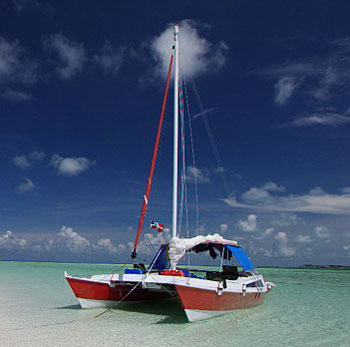
The boat in question is a Wharram Melanesia, plan number 696, designed by James Wharram and Hanneke Boon. It is a very unconventional design, to Western eyes, because it attempts to recreate, in modern materials, the traditional indigenous watercraft of the Pacific island peoples. To build a Melanesia in northern Colorado, about a third of the way around the globe from its home waters, may seem silly. But I chose the design because I admire its simplicity, its light weight, its potential speed, and its bigger siblings in the Wharram catalog. I'm hoping that this experience will provide the chance to dip my toes in the waters of boat building and to judge whether I have (or could acquire) the skills to build one of the larger Wharram designs some day.
In this inaugural post, I'm going to try to answer some of the questions raised by my apparent folly. Specifically:
- What are you doing with a sailing hobby over 1000 miles from the nearest salt water?
- What makes you think you can build a boat?
- Okay, but why on earth build such a strange boat?
- Are you sure this is a good idea? And what are your goals?
I moved to Colorado right after college, and have lived here ever since. For most of that time, sailing never crossed my mind. In the last four years or so, I've begun to get the sailing bug again. I purchased a beat-up old El Toro, a very small sailing dinghy comparable to an Optimist in size and layout, and found that my skills were only a bit rusty. (Part of the credit there belongs to Jan Adkins, whose beautiful little book The Craft of Sail provided an excellent refresher course. I can't recommend it highly enough - Adkins is an illustrator on par with the best of them, and he writes as precisely as he draws.)
Anyway, I took a sailing class at the Victoria Sailing School in Denver and achieved some basic ASA certifications. I found at that class that Colorado is actually full of sailors. There's some challenging sailing to be done in our regional reservoirs, where the topography keeps the winds swirling about and we're forced to constantly adjust sail trim. Denver is certainly not Annapolis, but there's nothing odd about living here and sailing.
What about this business of building a boat myself? I'll admit that this is a weak link in my chain of reasoning. My previous efforts at woodworking have been flawed at best. I'm able, after a lot of practice, to produce non-ugly dorm furniture and utilitarian shelving. But boats are a different matter, since they need to be water-tight, right?
 |
| The Teal, designed by Phil Bolger and Dynamite Payson |
I've actually learned a lot from that first project. I've also learned from other blogging boat builders that some other popular construction methods aren't as simple as they sound, either - strip planking, in particular, comes to mind. But I know several people who have built stitch-and-glue boats, and I'm convinced that stitch and glue construction - where precisely cut plywood shapes are joined along their edges, curving into the proper hull shape as their edges mate - will actually be more forgiving. Cutting the shapes out for the Teal has not been my problem; instead, it's been joining them cleanly. So I have high hopes. We'll see if they're well-founded.
Of course, stitch and glue is the most popular amateur boat building technique in the world these days. Why did I choose such an odd craft to build with so many designs to choose from? Well, to answer that question I need to go back to my personal sailing history a bit.
 |
| Sunrise at anchor in a cove behind Padre Island, TX |
The next year, we tried again in Southern California and had a terrible experience. The head began to back up, and the battery bank wasn't charging off the engine. We later learned that our charter's head had a clogged vent from prior customers; I'm still not sure what was wrong with the electrical system.
The second charter sticks in my mind. We were completely stranded by the electrical problem, and I realized that I'm not happy with the RV experience one gets from big keelboats. In my early 40's, I'm still an occasional backpacker and bicycle tourist. I'm not frightened by a lack of creature comforts; even my wife is an enthusiastic tent camper. I'd rather give up some of the luxury it is assumed one demands on a typical charter sailboat for greater freedom and simplicity.
And that's why I've fallen in love with James Wharram catamaran designs. They are designed for safety and performance, simplicity and affordability, but certainly not luxury. Even his smaller designs have circumnavigated and survived hurricanes, so they're clearly seaworthy. But if a sea kayak is akin to backpacking, and a standard charter yacht is akin to a 35-foot RV, the Wharram catamaran is somewhere in between. A VW camper bus, perhaps? As Goldilocks would say, just right.
 |
| Boatsmith's beautiful Tiki 30 would certainly suffice. |
Which brings us to the next question: is this really such a good idea? My father very wisely says that a successful project requires three things: time, money and work space -and in a pinch, passion can make do with two of the three. I have, let's see here... barely enough money for this small project, a little free time, and no dedicated work space. As I write this, I own the plans (around US$150 at the current exchange rates) and could afford to buy either the wood or the epoxy; I plan to start with the wood and save up towards the epoxy as I do the lofting and cutting. I will be borrowing general family spaces for this project and doing my best to stow it out of everybody's way in between work sessions. We have a screened, covered porch that I'm eying for that purpose, though I've been strictly forbidden from monopolizing it. Luckily, it has a tall ceiling and I think I can store the project overhead as it progresses. We'll see how that goes....
I've been told never to begin a project without a clear definition of success, so here's mine. This effort will be a raging success if:
- I get a fun, usable boat out of it
- the boat is reasonably attractive and structurally sound
- it is built on-budget
- I get an honest sense from the process of the value provided by the Wharram plans
- and I manage to do all of this without driving my wife and family to distraction in the process
- [and not to get too greedy, but I'd like to sail her before the end of this year]
As I mentioned earlier, I have the plans in hand now, and have begun sourcing materials. My next post will deal with suppliers, costs, and material selections. If you're still reading at this point, it should relieve you to know that I promise to be more succinct in the future.
Subscribe to:
Posts (Atom)