I managed only a little progress today. The lashing pads I cut out last night are shaped and matched, a process made vastly easier by the belt sander. There are 12 lashing pads, and I'm not great at assembly line work, so I had 12 slightly different rectangles when I set the saw down. No worries - clamp them tightly together and run the belt sander over the edges until they're all identical(ish).
I put the first coat of epoxy on the lashing pads this evening. While I was spreading epoxy, I coated the last little bit of the stem & stern post tapers, and did the flip side of the deck beams I started on yesterday. Here's the night's work, all layed out and curing.
Life is about to get a little busy again - some wet weather is headed our way, which forces me to stow my panels indoors and keeps me from using little scraps of time here and there for small boat tasks. And I don't expect any significant time to work on the boat out of the next five days.
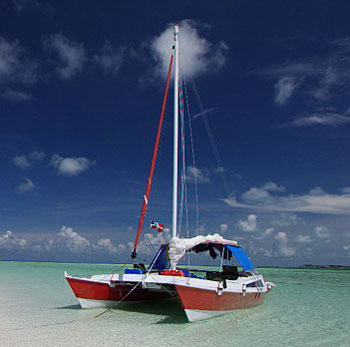
So I've started dreaming a bit, which is dangerous. (cue dream sequence sound effects...) One of my dreams for this boat is to take it on some coastal expeditions. I'd start out with something mild and forgiving, like Padre Island, Texas, but I'd love to someday sail California's Channel Islands in it, like Tim Anderson did in his slightly larger outrigger canoe.
And, don't forget, there are also the WaterTribe races, the "best known" example being the Everglades Challenge. All of their races are designed to test small craft and their skippers for versatility, seaworthiness, endurance and portability. Entrants frequently use sea kayaks or similarly minimalist boats, sometimes rigging a sail for the downwind portions. But there are also classes for small mono- and multi-hull sailboats. The Melanesia would fit the Class 5 definition, I believe, provided something were done about reefing the crab claw sail and building positive flotation into the hull. Personally, I'm not big on swamps, gators or mosquito clouds, so I might give Florida a pass. But the North Carolina Challenge? That sounds fun.
Whoah, there, did I just say out loud that I'd like to enter my as-yet-unbuilt outrigger canoe in a 100-mile endurance race, or sail it offshore in Southern California? That's crazy talk. Get the boat built, learn to sail it, try a little local camping expedition with it, maybe. That's lofty enough for the time being.
But it's definitely true that these crazy visions keep me motivated. There's not much glamour in mass-producing lashing pads, so every little bit helps.
Building (and hopefully sailing) a James Wharram "Melanesia" outrigger sailing canoe on the high plains far inland in the USA.
Showing posts with label goals. Show all posts
Wednesday, September 14, 2011
Monday, September 5, 2011
Momentum
| Stem post - what will become the bow. |
Stitching is a major milestone, because it's at this point that the boat stops being an entirely imaginary thing. As you can see in the photo at right, the stitching process transforms flat panel shapes into a curved hull section. It is now possible to squint and see the boat emerging from all of this work.
That said, I've really stitched more together here than I should have. The stem and stern post finish work isn't complete - there's Sharpie and rough epoxy visible on the stem post photo at right - so I need to extract them, sand 'em a bit further, and lay on some more epoxy before reassembly. I couldn't help myself, I needed to see the shape.
| Center frame forces panels near-horizontal; in distance, stem post forces panels near-vertical. Between, ply visibly twists into the proper shape. |
When you begin stitching the bottom panels together, there's nothing to keep them from lying flat, face-to-face. That's where the frames come in. There are two frames, one exactly amidships and another about 35" further aft. They force the plywood to lay almost flat at those spots, and the stem- & stern-post stitching force the plywood to lay almost vertically at the ends. In between, you get a "tortured plywood" hull shape that transitions gradually for the first 8' of the hull, and more quickly at the stern. This produces a sharper bow and a rounder stern, which are important in handling the canoe under sail later on.
Over the next week, I'll complete the second gunwale installation, drill the side panels to mate with the bottom panels and end posts, and complete the finish work on the end posts. Once those things are done, it will be time to complete the stitching, at which point I'll appear to have a hull. But the stitching wire's job is just to hold the hull in shape temporarily. That shape then gets bonded together permanently with fillets (thick seams) of thickened epoxy and fiberglass tape.
I suspect that the filleting will take a couple weeks worth of evenings and weekends, and there are the decks to install, too. So we're not likely to have a complete hull before mid-October at the earliest. And even then, there's the issue of coming up with the ama, outrigger poles, steering paddle, spars, completed sail, rigging.... sigh. This canoe will almost certainly not sail this fall. But it's conceivable that it might float as a paddling canoe before winter sets in. That would be great motivation for the finishing touches, so that I can have a proper launching in the spring.
Even that modest goal of a spring launch is the product of a rosy outlook, but it's a rosy outlook fueled by the vision of a hullshape finally starting to emerge from my odd collection of plywood shapes, and that should keep me rolling for a while.
Saturday, April 9, 2011
Getting Started Getting Started
This blog will document my efforts to build and learn to sail a small sailboat. As such, it's unlikely to be of interest to anyone except those considering building a boat themselves, or those who know me and wonder how my project is going. If neither of those descriptions apply to you, yet you continue reading, you have only yourself to blame for the wasted time!
The boat in question is a Wharram Melanesia, plan number 696, designed by James Wharram and Hanneke Boon. It is a very unconventional design, to Western eyes, because it attempts to recreate, in modern materials, the traditional indigenous watercraft of the Pacific island peoples. To build a Melanesia in northern Colorado, about a third of the way around the globe from its home waters, may seem silly. But I chose the design because I admire its simplicity, its light weight, its potential speed, and its bigger siblings in the Wharram catalog. I'm hoping that this experience will provide the chance to dip my toes in the waters of boat building and to judge whether I have (or could acquire) the skills to build one of the larger Wharram designs some day.
In this inaugural post, I'm going to try to answer some of the questions raised by my apparent folly. Specifically:
I moved to Colorado right after college, and have lived here ever since. For most of that time, sailing never crossed my mind. In the last four years or so, I've begun to get the sailing bug again. I purchased a beat-up old El Toro, a very small sailing dinghy comparable to an Optimist in size and layout, and found that my skills were only a bit rusty. (Part of the credit there belongs to Jan Adkins, whose beautiful little book The Craft of Sail provided an excellent refresher course. I can't recommend it highly enough - Adkins is an illustrator on par with the best of them, and he writes as precisely as he draws.)
Anyway, I took a sailing class at the Victoria Sailing School in Denver and achieved some basic ASA certifications. I found at that class that Colorado is actually full of sailors. There's some challenging sailing to be done in our regional reservoirs, where the topography keeps the winds swirling about and we're forced to constantly adjust sail trim. Denver is certainly not Annapolis, but there's nothing odd about living here and sailing.
What about this business of building a boat myself? I'll admit that this is a weak link in my chain of reasoning. My previous efforts at woodworking have been flawed at best. I'm able, after a lot of practice, to produce non-ugly dorm furniture and utilitarian shelving. But boats are a different matter, since they need to be water-tight, right?
It just so happens that this is not my first attempt at building a boat. My younger brother and I are currently in the final stages of building a Bolger Teal. The Teal is a so-called "Instant Boat," which means that it is built using a technique developed by the late Dynamite Payson. Instant Boats are of simple, forgiving construction - at least in theory. Our Teal project has been quite finicky, and I suspect that part of the reason is that the "instant" method is not foolproof. It relies heavily on chine and gunwale lumber to give shape to the plywood, and our lumber was a bit off; the resulting hull looks great from 10 or 15 feet away, but shows a lot of imperfections when you sight along its length.
I've actually learned a lot from that first project. I've also learned from other blogging boat builders that some other popular construction methods aren't as simple as they sound, either - strip planking, in particular, comes to mind. But I know several people who have built stitch-and-glue boats, and I'm convinced that stitch and glue construction - where precisely cut plywood shapes are joined along their edges, curving into the proper hull shape as their edges mate - will actually be more forgiving. Cutting the shapes out for the Teal has not been my problem; instead, it's been joining them cleanly. So I have high hopes. We'll see if they're well-founded.
Of course, stitch and glue is the most popular amateur boat building technique in the world these days. Why did I choose such an odd craft to build with so many designs to choose from? Well, to answer that question I need to go back to my personal sailing history a bit.
After my class at Victoria Sailing, I read about coastal navigation and took the family on our first charter vacation, bareboating in Corpus Christi, Texas. The trip was spectacular - good sailing, dolphin sightings, exotic shorebirds, great food... Nothing went perfectly - navigation and docking were a little hesitant, but functional - but it was all good enough that the beauty and thrill of the experience shone through.
The next year, we tried again in Southern California and had a terrible experience. The head began to back up, and the battery bank wasn't charging off the engine. We later learned that our charter's head had a clogged vent from prior customers; I'm still not sure what was wrong with the electrical system.
The second charter sticks in my mind. We were completely stranded by the electrical problem, and I realized that I'm not happy with the RV experience one gets from big keelboats. In my early 40's, I'm still an occasional backpacker and bicycle tourist. I'm not frightened by a lack of creature comforts; even my wife is an enthusiastic tent camper. I'd rather give up some of the luxury it is assumed one demands on a typical charter sailboat for greater freedom and simplicity.
And that's why I've fallen in love with James Wharram catamaran designs. They are designed for safety and performance, simplicity and affordability, but certainly not luxury. Even his smaller designs have circumnavigated and survived hurricanes, so they're clearly seaworthy. But if a sea kayak is akin to backpacking, and a standard charter yacht is akin to a 35-foot RV, the Wharram catamaran is somewhere in between. A VW camper bus, perhaps? As Goldilocks would say, just right.
In a perfect world, I'd go straight to one of his larger designs, like the Tiki 26 or 30, maybe even buying a pro-built one like the lovely Tiki 30 pictured at left. (It's for sale as of this writing, by the way.) But money's tight, my boatbuilding skills are, as yet, unproven, and my track record with large, complicated projects is uneven. So the Melanesia is a chance to test my skills, evaluate the quality of the plans Wharram provide, and all for a relatively modest cost.
Which brings us to the next question: is this really such a good idea? My father very wisely says that a successful project requires three things: time, money and work space -and in a pinch, passion can make do with two of the three. I have, let's see here... barely enough money for this small project, a little free time, and no dedicated work space. As I write this, I own the plans (around US$150 at the current exchange rates) and could afford to buy either the wood or the epoxy; I plan to start with the wood and save up towards the epoxy as I do the lofting and cutting. I will be borrowing general family spaces for this project and doing my best to stow it out of everybody's way in between work sessions. We have a screened, covered porch that I'm eying for that purpose, though I've been strictly forbidden from monopolizing it. Luckily, it has a tall ceiling and I think I can store the project overhead as it progresses. We'll see how that goes....
I've been told never to begin a project without a clear definition of success, so here's mine. This effort will be a raging success if:
As I mentioned earlier, I have the plans in hand now, and have begun sourcing materials. My next post will deal with suppliers, costs, and material selections. If you're still reading at this point, it should relieve you to know that I promise to be more succinct in the future.
The boat in question is a Wharram Melanesia, plan number 696, designed by James Wharram and Hanneke Boon. It is a very unconventional design, to Western eyes, because it attempts to recreate, in modern materials, the traditional indigenous watercraft of the Pacific island peoples. To build a Melanesia in northern Colorado, about a third of the way around the globe from its home waters, may seem silly. But I chose the design because I admire its simplicity, its light weight, its potential speed, and its bigger siblings in the Wharram catalog. I'm hoping that this experience will provide the chance to dip my toes in the waters of boat building and to judge whether I have (or could acquire) the skills to build one of the larger Wharram designs some day.
In this inaugural post, I'm going to try to answer some of the questions raised by my apparent folly. Specifically:
- What are you doing with a sailing hobby over 1000 miles from the nearest salt water?
- What makes you think you can build a boat?
- Okay, but why on earth build such a strange boat?
- Are you sure this is a good idea? And what are your goals?
I moved to Colorado right after college, and have lived here ever since. For most of that time, sailing never crossed my mind. In the last four years or so, I've begun to get the sailing bug again. I purchased a beat-up old El Toro, a very small sailing dinghy comparable to an Optimist in size and layout, and found that my skills were only a bit rusty. (Part of the credit there belongs to Jan Adkins, whose beautiful little book The Craft of Sail provided an excellent refresher course. I can't recommend it highly enough - Adkins is an illustrator on par with the best of them, and he writes as precisely as he draws.)
Anyway, I took a sailing class at the Victoria Sailing School in Denver and achieved some basic ASA certifications. I found at that class that Colorado is actually full of sailors. There's some challenging sailing to be done in our regional reservoirs, where the topography keeps the winds swirling about and we're forced to constantly adjust sail trim. Denver is certainly not Annapolis, but there's nothing odd about living here and sailing.
What about this business of building a boat myself? I'll admit that this is a weak link in my chain of reasoning. My previous efforts at woodworking have been flawed at best. I'm able, after a lot of practice, to produce non-ugly dorm furniture and utilitarian shelving. But boats are a different matter, since they need to be water-tight, right?
| The Teal, designed by Phil Bolger and Dynamite Payson |
I've actually learned a lot from that first project. I've also learned from other blogging boat builders that some other popular construction methods aren't as simple as they sound, either - strip planking, in particular, comes to mind. But I know several people who have built stitch-and-glue boats, and I'm convinced that stitch and glue construction - where precisely cut plywood shapes are joined along their edges, curving into the proper hull shape as their edges mate - will actually be more forgiving. Cutting the shapes out for the Teal has not been my problem; instead, it's been joining them cleanly. So I have high hopes. We'll see if they're well-founded.
Of course, stitch and glue is the most popular amateur boat building technique in the world these days. Why did I choose such an odd craft to build with so many designs to choose from? Well, to answer that question I need to go back to my personal sailing history a bit.
![]() |
| Sunrise at anchor in a cove behind Padre Island, TX |
The next year, we tried again in Southern California and had a terrible experience. The head began to back up, and the battery bank wasn't charging off the engine. We later learned that our charter's head had a clogged vent from prior customers; I'm still not sure what was wrong with the electrical system.
The second charter sticks in my mind. We were completely stranded by the electrical problem, and I realized that I'm not happy with the RV experience one gets from big keelboats. In my early 40's, I'm still an occasional backpacker and bicycle tourist. I'm not frightened by a lack of creature comforts; even my wife is an enthusiastic tent camper. I'd rather give up some of the luxury it is assumed one demands on a typical charter sailboat for greater freedom and simplicity.
And that's why I've fallen in love with James Wharram catamaran designs. They are designed for safety and performance, simplicity and affordability, but certainly not luxury. Even his smaller designs have circumnavigated and survived hurricanes, so they're clearly seaworthy. But if a sea kayak is akin to backpacking, and a standard charter yacht is akin to a 35-foot RV, the Wharram catamaran is somewhere in between. A VW camper bus, perhaps? As Goldilocks would say, just right.
| Boatsmith's beautiful Tiki 30 would certainly suffice. |
Which brings us to the next question: is this really such a good idea? My father very wisely says that a successful project requires three things: time, money and work space -and in a pinch, passion can make do with two of the three. I have, let's see here... barely enough money for this small project, a little free time, and no dedicated work space. As I write this, I own the plans (around US$150 at the current exchange rates) and could afford to buy either the wood or the epoxy; I plan to start with the wood and save up towards the epoxy as I do the lofting and cutting. I will be borrowing general family spaces for this project and doing my best to stow it out of everybody's way in between work sessions. We have a screened, covered porch that I'm eying for that purpose, though I've been strictly forbidden from monopolizing it. Luckily, it has a tall ceiling and I think I can store the project overhead as it progresses. We'll see how that goes....
I've been told never to begin a project without a clear definition of success, so here's mine. This effort will be a raging success if:
- I get a fun, usable boat out of it
- the boat is reasonably attractive and structurally sound
- it is built on-budget
- I get an honest sense from the process of the value provided by the Wharram plans
- and I manage to do all of this without driving my wife and family to distraction in the process
- [and not to get too greedy, but I'd like to sail her before the end of this year]
As I mentioned earlier, I have the plans in hand now, and have begun sourcing materials. My next post will deal with suppliers, costs, and material selections. If you're still reading at this point, it should relieve you to know that I promise to be more succinct in the future.
Subscribe to:
Posts (Atom)